
FORMULATION AND EVALUATION OF SODIUM ALGINATE BEADS AND SUSTAINED-RELEASE PELLETS OF RABEPRAZOLE SODIUM
-
 S. Madhankumar
Department of Pharmaceutics, Pallavan Pharmacy College, Kolivakkam, Kanchipuram, Tamil Nadu, India.
-
G. Mariyappan
Department of Pharmaceutics, Pallavan Pharmacy College, Kolivakkam, Kanchipuram, Tamil Nadu, India.
-
J. Karthi
Pallavan Pharmacy College, Kolivakkam, Kanchipuram, Tamil Nadu, India.
-
Prakash Murugan
Sai Mirra InnopharmPvt. Ltd., Ambattur, Chennai, Tamil Nadu, India.
Keywords:
alginate beads, Eudragit RS100, ionotropic gelation, rabeprazole sodium, sustained-release pellets, triethyl citrateAbstract
Background: Rabeprazole sodium is a proton pump inhibitor that degrades rapidly in acidic media. Prolonged-release oral forms must therefore limit its exposure to gastric acid while controlling its release in the intestine.
Objective: To develop and evaluate two independent multiparticulate systems of rabeprazole sodium, namely calcium alginate beads and Eudragit RS100-coated sustained-release pellets.
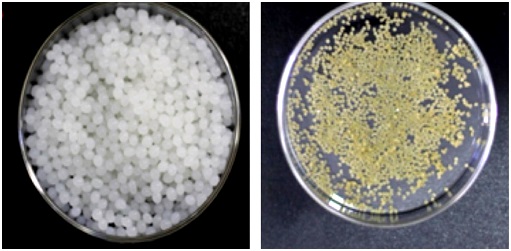
Methods: Calcium alginate beads were generated by ionotropic gelation using a two-factor, three-level factorial arrangement comprising sodium alginate at 2.0–3.0% w/v and calcium chloride at 1.0–2.0% w/v. A separate pellet series was manufactured by powder layering onto sugar spheres and subsequent application of Eudragit RS100 coatings containing triethyl citrate at 0–20% of the polymer mass. Characterization encompassed manufacturing recovery, drug incorporation, particle attributes and UV-derived apparent release. The selected pellet formulation underwent additional release-model fitting, scanning electron microscopy and storage assessment.
Results: Increasing the concentrations of sodium alginate, and calcium chloride increased bead yield (82.4–91.0%), entrapment efficiency (78.6–91.6%) and size, and decreased swelling and drug release at 8 h (from 91.8% to 73.5%). Formulation B5 showed a balanced profile with an entrapment efficiency of 87.6±1.0%. In the pellet series, increasing the triethyl citrate level progressively retarded drug release at 12 h, from 96.8% (F1) to 76.5% (F5). The drug content and 12 h release of F5 changed by less than two percentage points after 6th months of accelerated and 12th months of long-term storage.
Conclusion: Triethyl citrate concentration was a critical variable governing drug release from Eudragit RS100-coated rabeprazole sodium pellets. Formulation F5 met all predefined quality and release criteria and remained stable during storage, identifying it as a promising sustained-release multiparticulate candidate for further development.
Peer Review History:
Received 25 July 2026; Reviewed 3 September 2026; Accepted 8 October; Available online 15 November 2026
Academic Editor: Dr. Ali Abdullah Al-yahawi , Al-Razi university, Department of Pharmacy, Yemen, [email protected]
Reviewers:
Eyassu Mathewos, Department of Nursing, College of Medicine and Health Sciences, Wachamo University, Durame Campus, Durame, Ethiopia, [email protected]
Dr. Julie Ann S. Ng, Blk 18 Lot 6 Grandville 3 Subdivision Mansilingan, Bacolod City, Philippines. [email protected]
Downloads


Published
How to Cite
Issue
Section
Copyright (c) 2026 Universal Journal of Pharmaceutical Research

This work is licensed under a Creative Commons Attribution-NonCommercial 4.0 International License.







 .